
Showing posts with label 1812. Show all posts

Saturday, August 20, 2011

Footnote Is Now Called "Fold3"


On this day, we'd like to alert you to a change to the Footnote History and Genealogy Archives available to Athens Regional Library System cardholders via GALILEO. Their new name is Fold3, and when you first enter the site, you will receive this announcement of the change:
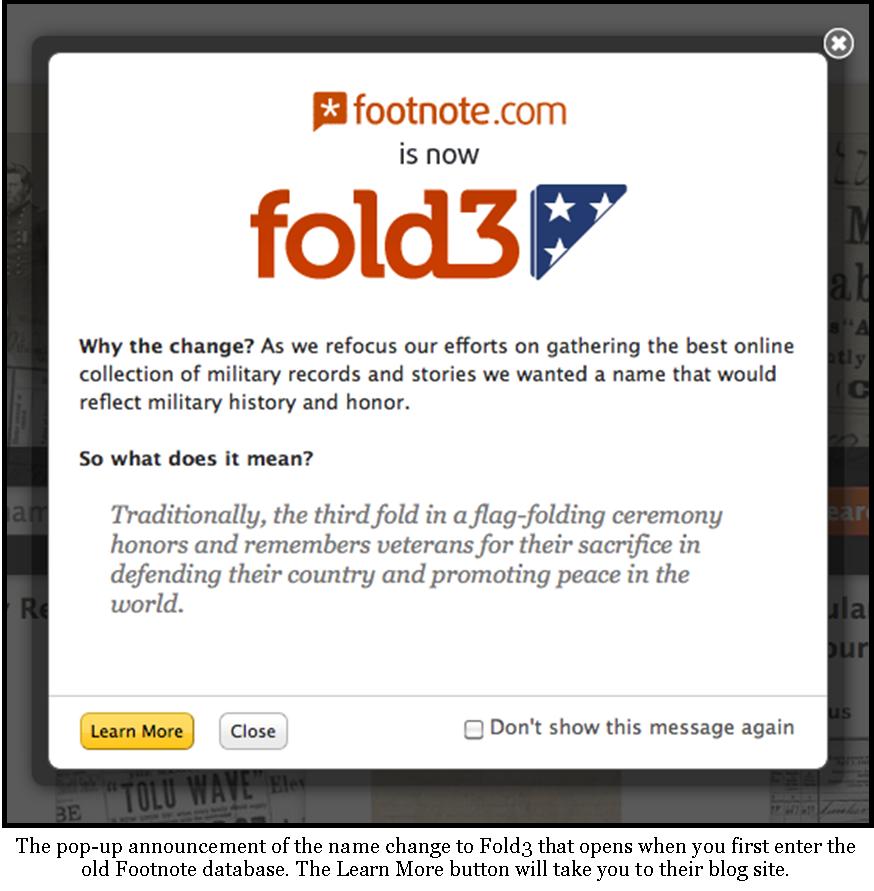


The name change is in honor of their new focus, which is primarily United States military records. As this is the vast majority of what they already hold, and why many use their site, the change is merely cosmetic for most history and family researchers who use this database. 

The site will not be eliminating their current non-military collections, such as city directories, U. S. Census documents, Native American records, and naturalization files. However, the site will not be adding new collections to these categories, as they move their focus to their military collections. Among the incomplete military collections that will benefit from the new focus are the War of 1812 Pension Files and several World War II collections.

When you visit the database now, the primary difference is the title of site and collections, as seen here:


Please let us know if you run into any problems, but so far, we've found the site is operating as normal. You can contact us at the Reference Desk by calling (706)613-3650, ext. 356, or emailing us at heritageroom@arlsmail.org.


Learn More:


Sunday, February 7, 2010

7 February 1905: Football Coach Wally Butts Is Born

On this day in 1905, James Wallace Butts, Jr. was born in Milledgeville, Georgia. He was a descendant of Captain Samuel Butts, a Virginia merchant who settled in Jasper County, and later fought and died with the Georgia state militia in the War of 1812; in 1825, Butts County, Georgia was named for him.

Wally Butts was captain of the football, baseball, and basketball teams at Georgia Military College preparatory school in Milledgeville, despite being only 5'6" tall and weighing 155 pounds. He earned athletic scholarships to Mercer University, where he played football for Coach Bernie Moore, later Commissioner of the Southeastern Conference. After graduation, Butts coached at the prep level for a decade, losing only 10 games in 10 years.

In 1938, he was hired as an assistant to new Georgia Bulldogs football coach Joel Hunt. During the South Carolina game in Columbia, Butts sat in the stands to look for Gamecock "weakness and strategy," and would send runners down to the sidelines with notes for the coaching staff. Georgia won 13-7.

Coach Hunt spent only a year at UGA, and Coach Butts was hired to replace him. He was 34 years old, with "the face of a cherub and the spirit of a hungry lion." For the next 21 years, he was the face of Georgia Bulldogs football, compiling a 140-86-9 record. He was known for his fiery temperament on the sidelines and during practice. Georgia's first Heisman Trophy winner, Frank Sinkwich, quit the team twice due to conflicts with Coach Butts, but in the end said that the coach "knew how to make a man out of a young punk."

Coach Butts took the Bulldogs to six bowl games, won four SEC titles, and two national championships, including a shared title in his 1946 undefeated season. In 1942, he coached the Bulldogs to a 9-0 win over UCLA in the Rose Bowl after a five-day, four-night train ride to Pasadena with no practice time and a Heisman Trophy winner with two sprained ankles. During the Second World War, he managed to have winning seasons with teams described as an "odd collection of brash young teenagers and 4Fs."

Butts served as Athletic Director through most of his coaching career at UGA, and insisted his home phone number be listed in the city directory, much to the dismay of his wife and daughters; all the phones in their house were red and black. Coach Butts also owned a diner called The Huddle on College Avenue where The Grill is located today.

Coach Butts was a longtime member of the College Football Rules Committee, served as President of the American Football Coaches Association, and was widely recognized as one of the great college coaches in the nation. For his biography, written at the end of his coaching career, the forward was penned by Ed Sullivan.

In 1960, Coach Butts retired from coaching and spent another three years as Athletic Director. In 1963, he moved to Atlanta to start the Wallace Butts Insurance Agency, which he moved to Athens several years later once the business was established. He was inducted into the Georgia Sports Hall of Fame in 1966. Coach Wally Butts died in 1973, and is buried at Oconee Hill Cemetery here in Athens.

On April 25, 1987, the Butts-Mehre Heritage Hall opened on the University of Georgia campus, housing athletic offices, facilities, and Bulldogs sports museum that is open to the public. In 1997, he was inducted into the College Football Hall of Fame, and in 1998 into the Georgia-Florida Hall of Fame.


Learn More: