Showing posts with label census. Show all posts

Friday, January 18, 2013

18 January 1831: A Local Census Tally


On this day in 1831, the Athenian posted this breakdown of the population count for Clarke county and the city of Athens:


In 1831, Clarke county was significantly larger than it is today, including all of the land now in Oconee county, which cut Clarke in half when it was created in 1875.

The black population is almost equal to the white population, but most interesting is the 29 "free colored" people living in Clarke county in 1831. Georgia had some of the harshest laws for free blacks, including forbidding them from becoming masons or mechanics, skills that would likely lead to economic stability. Georgia and Virginia were the only two southern states that did not allow free blacks to vote.

The state also gave anyone who suspected their supposedly white neighbors of  only pretending to be white to take them to court to make them prove they had less than 1/8th "Negro blood," lest they continue to have the privileges of marriage, literacy, suffrage, and professional employment. However, despite such hardships, free African-American communities did exist, such as Springfield near Augusta, Georgia.


Learn More:


Sunday, December 2, 2012

2 December 1904: Love Locked Up


On this day in 1904, the Weekly Banner published news of a recent local marriage that required some persuasion of the bride's parents:

LOCKED
Up Young Bride, But Parents
Finally Give Blessings
to Happy Couple.

   Love laughs at locksmiths is true but sometimes love forgets and gets locked up again.
   The first part of the aphorism was proven true on Sunday afternoon when Mr. Pink Hilyard and Miss Ophelia Hughes were married at the home of a friend near Winterville.
   Mr. Hilyard brought his bride back to the city and they went to the home of the bride's parents. A stormy scene followed and the parents refused to let Mr. Hilyard see his wife.
   Later during the evening the refusal was still adhered to and not until yesterday morning did the parents of Mrs. Hilyard relent and give the young couple their blessing.
--Weekly Banner, 2 December 1904, p. 5, col. 7.


Alas, Mr. and Mrs. Hughes had good instincts. Robert Pink Hilliard was well known in town for being arrested as drunk or disorderly (or both) rather than for being an industrious young man with a bright future. He was also only 18 years old, and Ophelia had only turned 16 a month earlier. In the 1904 Athens City Directory, his profession is listed as painter.

(click to enlarge image)

According to the 1910 U.S. Census, Ophelia and Pink were living with his parents on Lumpkin Street, with Ophelia at home, caring for their two sons, Hughes, age 4, and Douglas, age 2, and Pink listed as now working as a "hackman," or public carriage driver. 

However, the 1909 Athens City Directory lists Ophelia as living with her sister on Oconee Street, indicating the marriage was already showing signs of strain. Pink continued to rack up fines from his frequent appearances the Mayor's Court, to account for his for disorderly drunken behavior, at a cost of $2.50 to $30.00 per conviction. In 1912, he and two of his friends were convicted of robbery and sent to prison. Pink was pardoned and released in 1915.

In the 1920 U.S. Census, Pink is found living in a boarding house in Augusta, Georgia, with an occupation of "painter" and marital status of "married." Ophelia and her boys are still living with her older sister, Alma, who worked as a bookkeeper for Bernstein Brothers Furniture Store and was active in the Y.W.C.A. Extension Club. Though Ophelia lists her marital status as "divorced," she would not officially file for divorce from Pink until August, 1928. 

Neither Ophelia nor Pink would ever remarry. Pink would live out his days in boarding houses and Y.M.C.A. rooms in Augusta, dying in 1958 at the age of 70. Ophelia spent her life in Clarke County, dying in 1965 at the age of 77.


Learn More: 

Wednesday, September 5, 2012

Heritage Book Collection Reprieve!


On this day, we are happy to announce that during this last phase of construction, the available Heritage Room book collection will not be closed stacks, and you will have access to far more books than were noted in the last post.

The Heritage Room books are currently upstairs on two shelves that run along the far wall you'll see as you come to the top of the staircase. They are on the other side of the computer desks, on either side of the entrance to the new restrooms. The small cart for books that you are done using is next to the Athens-Clarke County books.

The temporarily smaller collection has a much closer focus on Georgia, including any Georgia county books that cover marriages, wills, cemeteries, deeds, or other abstracts taking priority in the collection. Some county histories have moved, if they provided this type of information. 

Also, all Georgia newspaper abstracts are available, as well as books with multiple counties of marriage or will records, land lottery books, the Pioneers of Wiregrass collection, Christian Index obituaries, U.S. Census indices, Georgia English Crown Grants, and Georgia Governor & Council Journals

For North Carolina and South Carolina, no county-focused books will be available for the time being, but there are U.S. Census indices, tax, will, marriage, deed records, as well as North Carolina Colonial Land Entries and South Carolina Royal Land Grants

For Virginia, you have access to Adventures of Purse and Person, Cavaliers & Pioneers, Colonial Abstracts, both sets of Genealogies of Virginia Families, Virginia Wills, and Wulfeck's Virginia Marriages

Still available for Civil War research are These Men Wore Grey, Rosters of Confederate Graves, Roster of Confederate Soldiers from the Official Records set, two rosters of Georgia Confederate Soldiers, and Sifakis's Compendium of the Confederate Armies

For the Revolution, we have Virgil White's collection of military pension and service record abstracts, Pierce's Register, the DAR Patriot Index, some Elijah Clark Chapter records, Helen Lu's Revolutionary War Period set, among other items. White's indices covering the War of 1812, the Mexican War, and the Indian Wars are also available.

There are also some general genealogy books for those who are getting started, need to know where to look for out of state or county records, or are trying to figure out where the heck the marriage record they need could be, such as the Red Book: American State, County, and Town Sources, and Map Guide to the U.S. Federal Census, 1790-1920

 
We are so happy we were able to make more available than anticipated, and in a way that allows you pursue your research at your own rate, picking the book you want or think you need from the shelf. If you find the book in PINES, we should have it available for you in the current Heritage collection. 


If you have any questions or concerns, do not hesitate to call us at the Reference Desk, at (706) 613-3650, ext. 356, or email us at Heritage.Room.Blog@gmail.com or heritageroom@arlsmail.org. We are still here to help you with your research! 


Saturday, April 7, 2012

7 April 1900: Mad Dog on Lumpkin Street


On this day in 1900, news of a mad dog attack was published on the front page of the Athens Banner:


The earliest descriptions of rabies come from the 23rd century B.C.E., and the word itself comes from the Sanskrit word "rabhas," which means "to do violence." Though Louis Pasteur and Emile Roux developed the first human vaccine for rabies exposure in France in 1885, at the turn of the century in the United States, more than 100 people died annually after being exposed to the disease. 


In 1900, domestic animals did not receive much in the way of veterinary care, and even humans did not receive many vaccinations. Before 1960, 90% of rabies cases came from exposure from domestic animals, such as dogs; by 2010, only 8% of cases could be traced to domestic animals, while the other 92% were found in raccoons, coyotes, bats, skunks, and foxes. Where you live determines which animal is most likely to carry the disease in your environment: along the eastern seaboard, raccoons are the primary carriers, while in the midwest, the primary carriers are skunks.


In the incident described above, the child, William Whitehead, was likely rescued by Mary Jones, the 25-year-old laundress who lived at 740 Field Street, near the Earl Whitehead household at 720 Field Street. The "hand" who chased down and killed the rabid dog was likely Mary's husband, 30-year-old Sam Jones, who is listed on the 1900 U.S. Census as a day laborer. The two had been married for five years at the time, though do not seem to have wed in Clarke County.


Learn More:

Sunday, April 1, 2012

1 April 1940: Census Workers Start Work in Athens


On this day 72 years ago, Enumerators hired by the U.S. Census Bureau started going door-to-door across Athens and Clarke County and the rest of the nation, asking questions of the city's residents such as:

  • Number of hours worked the previous week
  • If workplace was "Emergency Employment," such as the WPA, CCC, etc.
  • Income in the previous year
  • Value of home
  • Highest grade of school completed

For those born abroad, Enumerators were told to "give country in which birthplace was located on January 1, 1937." Therefore, someone who was born in Prague or Vienna would give their birth nation as Czechoslovakia or Austria, rather than Germany, which had occupied both nations in 1938. Enumerators were also instructed to distinguish between French and English Canada, and Northern Ireland and the Irish Free State. 


Because it has been 72 years since the 1940 Census was taken, at 9am on Monday, April 2nd, 2012, the National Archives will be releasing for free the digitized images of the 1940 Census. Due to privacy laws, the Census could not begin to be indexed before this date, but those who know where someone lived in 1940 have a couple of ways to shorten their search for the right Enumeration District they need.


The easiest way is using Steve Morse's Unified 1940 Census ED Finder. By entering address information, or the 1930 Enumeration District, the corresponding 1940 Enumeration District or Districts can be found.  


You can also find the reference map used by the U.S. Census Bureau to create Enumeration Districts by using Steve Morse's Viewing 1940 Enumeration District Maps in One Step utility. These maps have most street names, prominent structures such as schools and factories, lines indicating wards or districts within a city or county, and the Enumeration District for each area. 


So even if all you know is Aunt Katie "lived near the old Check Factory," you can still narrow down which ED is the place to begin your search. The National Archives estimates it will take at least six months to index the 1940 Census, so name searches should be available by the end of 2012.  


Next Saturday, 7 April 2012, the National Archives Southeast in Morrow, Georgia, will host a free workshop on the 1940 Census from 10am to noon. Registration is required, so call (770) 968-2100 or email atlanta.archives@nara.gov to reserve your seat or get more information.


Learn More:


Saturday, February 18, 2012

18 February 1890: Not Every "Romantic Marriage" Has a Storybook Ending


On this day in 1890, the Weekly Banner told this story of a local wedding ceremony held in town the previous week:


A ROMANTIC MARRIAGE.
Mr. Albert Henley Weds Miss Lula Crawford.
       Wednesday witnessed one of the happiest, as well as one of the most romantic weddings that Athens has seen for some time.
       Sudden in its ceremony and romantic in its nature, it caused no little interest to be aroused all over the city.
       Mr. Albert P. Henley, a prominent attorney of this city wedded Miss Lula Crawford, one of the pretiest [sic] and most estimable young ladies in Classic Athens.
       The wedding took place at 12 o'clock at the house of Mr. C. D. McKie, on Hancock avenue, Rev. W. D. Anderson performing the ceremonies. It was conducted in haste, as it is said that the Wedding had not met with general favor from relatives of the happy couple. Immediately after the marriage the couople were driven to the C. & M. train and left on a trip to Florida and the tropic lands, by orange trees shaded.
       Both parties are too well known to enter into narrations of their lives. They were popular and much beloved by those who knew them intimately. The congratulations and good wishes of hosts of friends attend through life.  
 
--Weekly Banner, 18 February 1890, p. 7, col. 3.

The day the announcement appeared in the newspaper, the couple's marriage license was recorded in the Clarke County Ordinary Court:


(click to enlarge image)


Sadly, when looking in the 1900 U.S. Census to see how the couple was faring a decade after they wed, Mrs. Henley was listed as a widow, living with her two daughters, 9-year-old Frances and 4-year-old Hiram (who was named for her uncle).  


By checking the Heritage Room's Guide to Microfilmed Records and the Digital Library of Georgia's Athens Historic Newspaper Archive, the fate of Albert Henley was revealed to be suicide by pistol on or about 3 February 1896. The account in the Weekly Banner paints a sad story of a promising life cut short:


       Then came the tempter to the young man in the shape of the wine cup and he yielded to its blandishments. The thirst for strong drink got the advantage of him and he went from bad to worse, despite his own efforts and those of friends to save him. His wife and two little girls were compelled to separate from him on account of his habits.
--Weekly Banner, 7 February 1896, p. 1, col. 7.


In a note he left for his law partner, former Athens Mayor and Clarke County Representative Henry C. Tuck, Albert Henley asked that his clothes be given to his servant, his pocket watch to his brother in Greene County, and that he be buried in Oconee Hill Cemetery. He also "wrote in the tenderest manner of his wife, and ended up by writing, 'God bless my children.'"


Mary Lou, or "Lula" Henley took over her brother's part in the wholesale grocery business Webb & Crawford after his death, and lived on Cobb Street until a fire destroyed her home there in August, 1902. She remarried in December, 1902, to William D. Beecham, and in 1903, after selling her part in the grocery business, joined the Athens Women's Club. 


With her new husband, Mary Lou had two sons, William D. Beecham, Jr. in 1904 and Jack G. Beecham in 1906. Her daughter Frances had a lively time as a student at Lucy Cobb Institute, often appearing on the Athens newspapers' society pages until her marriage to Harry Woodruff of Columbus, Georgia, in 1913. 


To trace the family over time, it was important to look for Mary Lou in the 1900 Census when Albert could not be found. In later years, tracing with the children's names became useful, when William was listed simply as "W.D." and "Beecham" often spelled as "Beacham." 


The 1910 U.S. Census gives the Henley daughters' last name as "Beacham," even though they are listed as step-daughters to William, but a quick scan of the Athens newspapers from that time indicates this was a mistake by the census taker, not that William had adopted the girls. In 1920 and 1930 Censuses, Hiram is properly listed as "Hiram Henley," still living with her mother and step-brothers. Hiram would never marry. 


Learn More:


Monday, January 23, 2012

23 January 1845: Marriage & Death Announcements from Around the State


On this day, the following marriage and death announcements appeared in the Southern Banner:


(click on image to enlarge)


The announcements are not only covering local marriages and deaths, but from all around Georgia. A smaller population, and the need to fill all the space in each week's paper, made publishing such notices a normal practice by many early newspapers. 

The wide scope of such announcements is also why we advise researchers not to limit themselves to the newspapers from the city or county where their family lived. Many counties did not have their own newspaper in the 1800s in Georgia, and even those that did have gaps in their collections, have not been abstracted or digitized, or maybe were lost entirely over time. 

The dates for the deaths are from January ("instant" or "inst" indicates the same month as published), while the marriages are from both January and December ("ultimo" or "ult" indicates the previous month). 

The marriages, as was the custom at the time and often today, were held in the bride's home county. This tradition makes such announcements an important part of tracking where to look for marriage certificates and maternal lines, especially when the county where your family "has always lived" has few of the vital records you would expect to find. 

Two people from "Clark" county with the last name of "Lester" were married on the same Thursday. Much like the Carlton siblings two years earlier, it is possible this brother and sister married on the same day. Because these couples were wed in 1845, we can use the 1850 United States Census to peek in on their lives just a few years later. 

In 1850, Josiah (now 26) and Emily (now 23) Lester were living in High Shoals with their three-year-old daugher Elizabeth J. and one-year-old daughter Regina E.; Josiah Daniell (now 23) and his wife Elizabeth Susan (now 21) are living in Watkinsville with their three-year-old son James W. and one-year-old son Young H. The name of the younger son could indicate that the family was Methodist (if the child was named for Young L. G. Harris).

Though it is difficult to find Absalom Gray in the 1850 Census, in 1860, he is now 56 years old and still living in Griffin, with a different wife, 45-year-old Mary A. Gray. The two children in the house, Mary J. E. Gray (21 years old) and Francis A. Gray (18 years old) would have been born to Sarah before her death.

It's worth your time to check several papers when trying to find reference to an ancestor or that maternal line that seems to have just disappeared into the past. 

Learn More: 

Thursday, January 19, 2012

Don't Miss Out! Sign Up for Our Newsletters!

On this day, we'd like to remind you to subscribe to our two free Heritage Room newsletters. 

Our Genealogy and History Events newsletter covers everything from webinars by the National Archives in Atlanta about the 1940 Census and lock-in research evenings at the Oconee County Library in Watkinsville to exhibitions about George Washington Carver at the Carter Presidential Library in Atlanta and furniture by Athenian Henry Eugene Thomas at the Georgia Museum of Art here in town. Rather than keep up with a million postcards, flyers, and emails, we put all the coming events of the month into a neat package or two that you can use to ensure you don't miss a thing.

Our Genealogy News and Tips newsletter keeps you in the loop with the latest resources available for research, such as the Tennessee Death Records recently added to the Ancestry database and a link to the new searchable online index of Alabama probate records. It also covers updates about the release of the 1940 Census (available on April 2, 2012, at 9am EDT) and fun things, like the new Henry Louis Gates PBS program, Finding Your Roots, and when the new season of Who Do You Think You Are? returns.


Click here (or either of the above newletter links) to read the current newsletter and subscribe to have them delivered. It couldn't be easier, and is a great time saver, so sign up today!

Saturday, August 20, 2011

Footnote Is Now Called "Fold3"


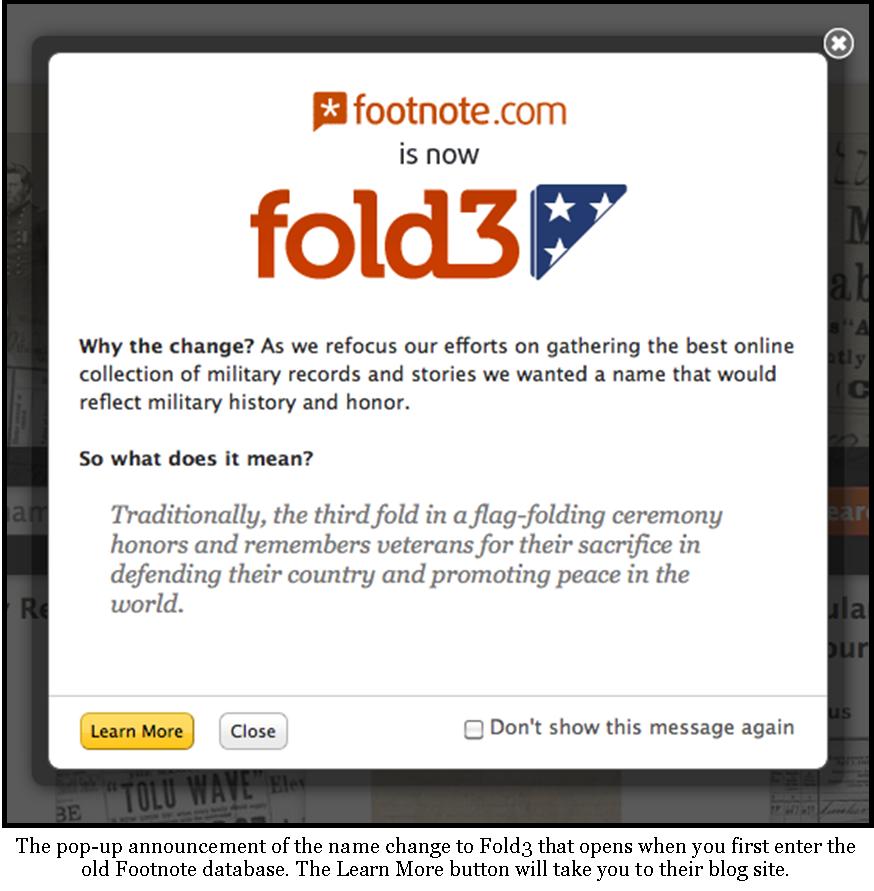
On this day, we'd like to alert you to a change to the Footnote History and Genealogy Archives available to Athens Regional Library System cardholders via GALILEO. Their new name is Fold3, and when you first enter the site, you will receive this announcement of the change:


The name change is in honor of their new focus, which is primarily United States military records. As this is the vast majority of what they already hold, and why many use their site, the change is merely cosmetic for most history and family researchers who use this database. 

The site will not be eliminating their current non-military collections, such as city directories, U. S. Census documents, Native American records, and naturalization files. However, the site will not be adding new collections to these categories, as they move their focus to their military collections. Among the incomplete military collections that will benefit from the new focus are the War of 1812 Pension Files and several World War II collections.

When you visit the database now, the primary difference is the title of site and collections, as seen here:


Please let us know if you run into any problems, but so far, we've found the site is operating as normal. You can contact us at the Reference Desk by calling (706)613-3650, ext. 356, or emailing us at heritageroom@arlsmail.org.


Learn More:


Friday, July 8, 2011

8 July 1899: Opera House Hosts Night School Exhibition


On this day in 1899, the East Athens Night School hosted its second annual exhibition at the Athens Opera House. The
Athens Daily Banner announced the event and location on their front page the day before, along with the Honor Roll for the term:


The East Athens Night School began in 1897 and was put under the direction of Miss Louie A. Lane, the daughter of the longtime pastor of the First Presbyterian Church in Athens. She was a graduate of the Lucy Cobb Institute, and became a school teacher. Known to all as "Miss Louie," she never married and became, in the words of Susan Frances Barrow Tate, "a one-woman welfare society."  

Miss Louie lived in East Athens, where many of the mill workers also lived. As a teacher, it bothered her that so many children in Athens had to work while the public schools were open, and therefore would never get an education or have a chance at improving their lives. Whenever a family needed clothes for their children, blankets, even food, Miss Louie would consult her list of good hearted women of Athens to find the items she needed. Many of these same women were responsible for setting up the East Athens Night School in the first place, publicizing the cause in the newspaper and holding socials at the Y.W.C.A. to raise money and get donations of school books, notebooks, paper, pencils, and even desks and chairs. They were always in need of more school books, as well as books of all types for the school's small lending library, which received heavy use by the students. Even after the Night School was incorporated into the Athens school system, donations were still required to meet demand.

The first night of school in early December, 1987, 10 students enrolled. Less than a week later, there were 18 students enrolled, including "two girls, 12 and 13 years of age, who are just now receiving their first opportunity to learn their alphabet." Twenty days after the school opened, there were 27 students enrolled, and they had, as a group, decided not to take any holiday for Christmas. After a month of operation, 40 students had enrolled and 15 more wanted to, but the room, an empty store front on Oconee Street, could not hold more students. A new room was added, and by the end of the term, a total of 68 students had enrolled. 

According to the 1900 U.S. Census, most of the students on the Honor Roll listed in the story above were between 12 and 21 years old in 1899, and most worked at the cotton or knitting mills, though the Patterson brothers were listed as "Harness Makers." 


Classes lasted from 6:30pm to 9pm "every night in the week except Saturday." Miss Louie told the Banner that the students "are anxious to learn and that her work is thus rendered exceedingly pleasant." The following term, Miss May Smoak was added as a teacher's assistant, but the school continued to grow, and by 1901 had over 150 students enrolled, including many adults who had never been taught to read and write. Business classes in bookkeeping were added, and over the years, the school allowed children who worked in the mills during the day to have the skills to eventually work as clerks in downtown offices as well as start their own businesses. All of them remembered and would often visit with Miss Louie, who never left her little home in their old neighborhood.

When Miss Louie died in October, 1939, the Athens Banner-Herald called her "the Jane Addams of Athens, who devoted her life to a career of unselfish service to humankind."  She was called "unassuming, understanding, generous, intelligent, and loving" and the paper noted that "she could hardly help being held up by others as a shining example of the things she strived so hard to inculcate in all with him she was associated."  Among her pall bearers were some of her students from the East Athens Night School's first few years. She is buried in an unmarked grave with her family at Oconee Hill Cemetery.


Learn More:

Friday, May 27, 2011

27 May 1828: "Girls beyond the power of enumeration"


On this day in 1828, the Athenian newspaper published this bit of local demographic data:


This population estimate seems to be for within the city limits of Athens, which was only a few blocks of downtown and the streets around North Campus at the time. The U.S. Census total population count for Clarke County in 1830 was much higher, 10,176 people. According to the 2010 U. S. Census, Athens-Clarke County has 115,424 residents. 

The numbers of carriages was an indicator of wealth, as was, apparently, the number of marriageable widows in town. A more accurate indicator can be found in the county tax records, where from 1819 to 1829, tax revenue in Clarke County increased by nearly 35%.

The University of Georgia was referred to as "Franklin College" in its early years. In 1828, total student population was 105 young white men. Women would not be admitted as undergraduates for another 90 years; African-Americans not for another 133 years. Today, the number of students at UGA's Athens campus is nearly 34,000, with a ratio of women to men of 58% to 42%, still pretty good odds for most male students.


Learn More:

Sunday, May 15, 2011

15 May 1856: "In plentitude, and even splendor..."


On this day in the Southern Watchman, the following paid announcement was published on page 4:


John Flournoy was a frequent "correspondent" in the Athens newspapers of the 1850s. Approximately six weeks later, he published another notice on this topic:


NOTICE.
THE public will be re-assured to observe that I will pay nothing not cognisable by me as a debt! My wife alternately leaves me and returns, and is now re-absconded--uncertain whether or not to come home any more. My offence is inability to support her in the extravagance she wants.  I can scarcely call a dollar my own.  The genius of woman is the talent of Satan. She it is, as a tool--that brought all our woes; and she it is that MUST be overmastered! I would not give a thrip for such a society or liberty as we now have, until it be reformed in a thousand condign ways . So, no farther advice on this point.
J. J. FLOURNOY

Beyond requests for local merchants to ignore his "wife, ANY wife, or wives," Mr. Flournoy also had run-ins with local businesses and neighbors that would be aired in overwrought prose amongst the ads for patent medicines, mills for sale, new shipments of goods, and county legal notices. Athens newspapers were not alone; he regularly wrote to papers all over Georgia, including Augusta and Macon, and religious publications.

Mr. Flournoy was a resident of Jackson county. In Jackson county record abstracts, there is reference to both "J. J. Flournoy" and "John Jacobus Flournoy,"never a "John James Flournoy," but they appear to be the same person.

According to Historic Notes on Jackson County, Georgia, John Jacobus Flournoy had been a native of Clarke, but moved to Jackson County in 1839. He lost his hearing and speech when he was young, and is considered instrumental in having the Georgia General Assmbly create the School for the Deaf at Cave Springs, Georgia in 1846; the school still operates today. In the book, Mr. Flournoy is described as "quite eccentric," and notes that he "wrote various articles expressing his dislike for society in general."

In 1858, calling himself "Dr. J. J. Flournoy," he offered a cold preventative method for winter colds only; he admitted he had not yet found a way to prevent summer colds. In 1859, he requested that people not call him "old Flournoy," but rather "old Mr. Flournoy." By the start of the Civil War, his notices were no longer quite so florid, advertising for a lost horse, watch, and a runaway slave, and later being noted by the paper with other contributors to the Sick and Wounded Soldiers Wayside Home in Athens. 


In March, 1874, the Macon newspaper noted that J. J. Flournoy had "perhaps, written more letters, on more subjects, to more people than any man that ever lived or will live to the end of time." By the 1870s, his letters to the Athens papers were somewhat less frequent. An editorial in an 1886 Banner-Watchman mentions Mr. Flournoy as "lately deceased," and calls him "a gentleman of immense personal courage." His exact date of death is unclear, but his age is listed as 61 in the 1870 U. S. Census, so he was approximately 77 years old when he died.


Learn More: