Showing posts with label WWII. Show all posts

Wednesday, March 28, 2012

Fourth Heritage Room Genealogy Class at the Athens Community Council on Aging


On this day, we'd like you to know that the Heritage Room's fourth class at the Athens Community Council on Aging will be on Wednesday, April 4th, 2012, from 1:00pm to 2:30pm in the Harris Room's ACCA Hoyt Street location. The title of the class is Finding Those Who Served: Military Records.


If you missed the first class, don't worry! Each class is independent, so if you are set on the basics, but want to know more about service records or using draft cards and pension records in your research, just sign up now for the April 4th class.  The class is free to members of the ACCA's Center for Active Living. Though free for members of CAL, pre-registration is required.

In our forth installment, we'll demonstrate the width and breadth of the war-related information available and useful for genealogical research. Our overview will cover what the records are, what sort of information they contain, and where they are located going back to Colonial times.

For more information about the classes, please call us at the library, (706) 613-3650, extension 356; to register, please call the Athens Council on Aging at (706) 549-4850 or consult their online program catalog, Senior Center Scene.


Tuesday, November 29, 2011

29 November 1945: "Cheer Up! Bacon Long Dreamed of Is Coming Soon"


On this day in 1945, the Athens Banner-Herald announced that "the supply of pork has overtaken the demand," so bacon, and other pork products such as lard, would finally become more available in the near future. 
According to the story, "cold weather has brought on a heevy [sic] hog slaughter on southeastern farms, but...most of the meat and fats would be used replenish home shortages." Thus, the paper's encouraging headline to "Cheer up!"


During World War II, many items were rationed by the United States government, including meat, rubber, sugar, shoes, metal, dairy products, and gasoline. An Office of Price Administration was established in 1941 to place ceilings on prices for some goods to keep prices within the reach of most Americans, and to ration the items that were most needed by the troops during the conflict. Though meat rationing ended in November, 1945, labor shortages meant lower crop yields in the months following the end of the war. 


Learn More:

Saturday, November 19, 2011

19 November 1953: Opening of the Ilah Dunlap Little Memorial Library


On this day in 1953, the new Ilah Dunlap Little Memorial library opened on the North Campus of the University of Georgia. 


Ilah Dunlap was born in February of 1874 to Mary Anne and Samuel Scott Dunlap in Bibb County, Georgia. She was the fifth daughter in a family of six children. Her father was a Captain in Phillips Legion during the Civil War, who started out as a farmer, then later became a successful merchant and city alderman in Macon. 


In 1896, Miss Dunlap married Leonidas A. Jordan.  Mr. Jordan owned Oakland Plantation in Lee County, Georgia, and died within four years of their marriage. In 1900, Mrs. Ilah Jordan is listed as the 26-year-old widowed head of a household in Macon that included her brother Samuel S. Dunlap, Jr.; her profession listed as "Capitalist." She was regularly featured in the Macon Telegraph Society page, often in relation to bridge club meetings or trips to Atlanta and New York. 


In 1906, she married John D. Little, an Atlanta lawyer, and moved to Fulton County. She was already widowed when she died in late July, 1939, on a vacation with a friend in German-occupied Czechoslovakia, just one month before Hitler's invasion of Poland and the start of World War II.  Though her will left $400,000.00 to the University of Georgia for a library, the settlement of the estate took a prolonged period of time.  Much of her jewelry and effects took more than a year to be returned to her executor in Macon, as both the American consulate and German officials had greater priorities than her estate, and faced disruption in communication, the latter sometimes noted in the communiques between various government agencies.


Mrs. Little's bequest gave the impetus to fund a much-needed upgrading of University of Georgia library facilities. UGA had only 185,000 volumes, compared with 751,000 at the University of Texas and 352,000 at the University of Kentucky. The cost to build the library was $2,000,000.00, and the operating budget for the library was increased dramatically as well. The University of Georgia President, Harmon Caldwell, argued that a $1,000,000.000 operating budget was necessary to make the library one that could compete with other southern schools after World War II.

The day after UGA's library opened , the Georgia Institute of Technology had the grand opening of their new Price Gilbert Memorial Library, and the weekend was a series of festivities in both cities to celebrate the events. 


Among those who participated in the celebrations were now University System Chancellor Harmon Caldwell; University of Georgia President O. C. Aderhold; Georgia Attorney General Eugene Cook; and members of the University Board of Trustees. Invited guests included Dr. K. Y. Metcalf of Harvard University; Derner Clapp, Acting Librarian of the Library of Congress; and Ralph Ellsworth, Director of Libraries for Iowa State University. Claude Davidson, Jr., director of the UGA news bureau, even composed a poem for the occasion.


In his dedication address, Dr. Ellsworth praised Georgia for opening two major libraries, stating that, "Only a vigorous University can overcome the terrible inertia that always seems to develop when a new library building is needed. Universities that are on the decline don't build new libraries."


UGA recently completed construction on a new Special Collections Library on Hull Street. Such collections as the Richard B. Russell Library, the Hargrett Rare Book & Manuscript Library, and the Peabody Awards collection are in the process of moving into their new space. The building will open officially in January, 2012.


Learn More:

Friday, September 23, 2011

23 September 1884: Eugene Talmadge Is Born


On this day in 1884, Eugene Talmadge was born outside Forsyth, Georgia, to Carrie and Thomas Talmadge. Fifty-six years later, he would ignite the largest crisis in the University of Georgia's history, causing UGA and all other state-funded schools to lose their accreditation by the Southern Association of Colleges and Schools (SACS), and dooming his re-election chances in 1942.


The controversy began in the summer of 1941 when Governor Talmadge, then a member of the recently created Board of Regents, acted to remove UGA's Dean of Education, Walter Dewey Cocking, on the charge that Cocking had advocated integrating a demonstration school near the University campus. Though the assertion had originally been made by a disgruntled former teacher without any evidence, and a ally of Talmadge on the Board had told him that the allegation had no merit, the Board voted to remove Dr. Cocking from his post. 


When the popular and respected UGA President Harmon Caldwell heard what had occurred, he sent word to the Board that he would resign if Dr. Cocking was fired without a chance to address the charges. The Board reconvened and conducted a four-hour inquiry that included testimony on behalf of Dr. Cocking from 16 College of Education faculty, President Caldwell, and the Presidents of Emory University and Agnes Scott College. The only person to testify against Dr. Cocking was the fired staff member, and the Board voted to rehire.


Incensed at this result, Governor Talmadge insisted that by fall quarter, Dr. Cocking would no longer be in office. He initiated changes to the Board of Regents in order to appoint more people who would vote for removal, and any other changes he wanted to make to the system. He asked for the resignation of three members, but was refused, and even altered the papers of appointment for one member to show the regent's term ending in 1941 rather than 1947, calling it a clerical error. His next vote to remove Dr. Cocking, with his newly constituted Board, passed 10-5.


At the same time, Talmadge was using Dr. Cocking's relationship with the Julius Rosenwald Fund, which had a large program of building schools for rural African-American students, to prove that Dr. Cocking was untrustworthy, and insisted that communist conspiracies meant that all state-funded libraries must remove any books or periodicals that he deemed as advocating "social equality" or communism . He also began removing more people from their positions in the University System, insisting that the schools be rid of "foreigners," which to Governor Talmadge meant that they were not from Georgia. 


On campus, tempers ran high. In October, the Southern University Conference had dropped the University of Georgia from its rolls, which caused outrage on campus. Students burned effigies of Talmadge on at least three separate occasions, and protested in Atlanta with motorcades 120 cars long. 


On October 31, 1942, the Red and Black published 16,000 copies of a state-wide edition distributed to all state colleges, alumni, and members of the General Assembly. The special edition included editorials, letters, articles about protest plans and solidarity pledges from private schools such as Emory and Mercer, poems about the situation, and excerpts of articles taken from state newspapers, the New York Times, Life magazine, and Time magazine. A front page editorial called for "all honest people of the state to cooperate with the students in the University System to put their power against the present 'dictator,'" and called those who did Governor Talmadge's bidding "a bunch of stooges," warning that "A tyrant always loses in the end and the small mice that follow the rat lose with him."


The Southern Association of Schools and Colleges created a committee to investigate what was happening in higher education in Georgia. At their December meeting, SACS voted unanimously to revoke accreditation at the University of Georgia and all other state-funded institutions. In order to allow current seniors to graduate, the invalidation would not go into effect until Fall Quarter, 1942. 


Though many schools had drops in enrollment due to the United States entry to World War II, UGA's dropped by 37%. Both the American Medical Association and the American Bar Association withdrew their support from Georgia's professional schools, and the situation received national attention. 


The lost accreditation was a step too far for most citizens of Georgia. During the 1942 gubernatorial race, Governor Talmadge was challenged by 36-year-old state Attorney General Ellis Arnall, and lost decisively due to the accreditation issue and the enthusiastic student campaign support for Arnall. On the day of his inauguration, Governor Arnall took the time to meet with two young University students, George O. Marshall and George Doss, just as Marshall, having enlisted in the Army, was about to report to Fort MacPherson.


Governor Arnall's first act was to pass reforms to the Board of Regents that diminished the influence of the governor and legislators on the schools, changes that were added to the Georgia constitution and passed by the citizens of Georgia in the next election.


Eugene Talmadge ran for governor again in 1946 and won. However, he died just weeks before taking office on December 21, 1946. His son was eventually elected by the legislature to take his place.


Learn More:


Saturday, August 20, 2011

Footnote Is Now Called "Fold3"


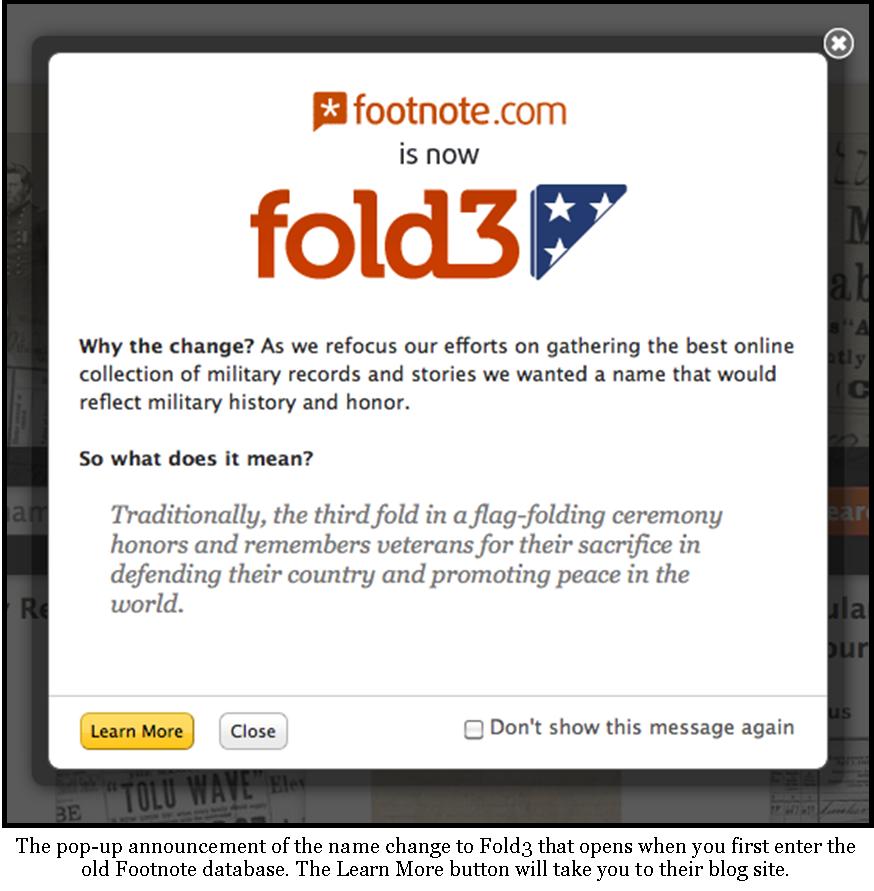
On this day, we'd like to alert you to a change to the Footnote History and Genealogy Archives available to Athens Regional Library System cardholders via GALILEO. Their new name is Fold3, and when you first enter the site, you will receive this announcement of the change:


The name change is in honor of their new focus, which is primarily United States military records. As this is the vast majority of what they already hold, and why many use their site, the change is merely cosmetic for most history and family researchers who use this database. 

The site will not be eliminating their current non-military collections, such as city directories, U. S. Census documents, Native American records, and naturalization files. However, the site will not be adding new collections to these categories, as they move their focus to their military collections. Among the incomplete military collections that will benefit from the new focus are the War of 1812 Pension Files and several World War II collections.

When you visit the database now, the primary difference is the title of site and collections, as seen here:


Please let us know if you run into any problems, but so far, we've found the site is operating as normal. You can contact us at the Reference Desk by calling (706)613-3650, ext. 356, or emailing us at heritageroom@arlsmail.org.


Learn More:


Saturday, January 15, 2011

15 January 1954: The Navy Supply Corps School Has Commissioning Ceremony

On this day in 1954, Mayor Jack Wells declared it to be "United States Navy Day" in Athens in honor of the official commissioning of the new Navy Supply Corps School. Local businesses would fly the American flag outside their establishments to welcome the dignitaries arriving in town for the ceremony, and many also purchased ads in the Banner-Herald to welcome the school, faculty, and cadets to Athens.

The noon ceremony was moved indoors to Pound Auditorium due to weather, and the featured speaker was Navy Assistant Secretary Raymond H. Fogler. Secretary Fogler discussed "the immensity of the Navy as a business," noting that supply corps ensure that every possible need for 400 combat vessels, 10,000 planes (with approximately 8,000 parts each), and 600,000 Navy men is met, from toothpaste to spatulas to replacement parts for jets and vessels. Mayor Wells noted that after hosting students of the Navy Pre-Flight School during World War II, "there is a soft spot in the heart of Athens for the Navy," and "We are glad to have them in our city."

The efforts of Georgia Representatives Carl Vinson and Paul Brown to bring the school to Athens were acknowledged by all speakers.

The Navy Supply Corps School was moved to Athens from Bayonne, New Jersey. It began with 400 students and 41 staff, with many of the officers bringing their entire families to Athens. Outside of training and classes, the school also had recreational athletic programs, an Officers Wives Group to organize and sponsor social events, a pistol team, a Philosophy Club, the Supply Line campus newspaper, the Oak Leaf school classbook, a debating society, and a choir.

The Navy Supply Corps School officially closed on October 29, 2010, as part of the graduation ceremony for the 82 men and women who are the last graduates of the Athens campus. Over the years, the school on Prince Avenue graduated 22,455 Navy "businessmen." Said Captain James Davis, NSCS commanding officer, "it is now our duty to bring the Athens spirit north and continue the Supply Corps legacy established during our 57 years in the Classic City."


Learn More:

Tuesday, July 27, 2010

27 July 1882: Michael Brothers Open for Business

On this day in 1882, Simon and Moses G. Michael went into the dry goods business as Michael Brothers. Simon was 23 and M. G. was 20. Their store was on the corner of Jackson and Broad Streets, taking half a floor of a two-story wooden building that also housed the city jail and police court.

Within three years, their business grew large enough that they needed the whole building, so the police court and jail moved. They added wholesale to their retail business, and hired traveling salesmen to visit stores in smaller towns in the region. Five years later they built a larger, three-story brick building on the site, staying open during construction by renting sales space in the Athens Hardware building.

In 1893, they moved to the corner of Jackson and Clayton Streets. They had razed the two-story wooden laundry building on the lot to erect a five-story stone building that took up one-third of the block along Clayton Street. The first two floors were dedicated to department-store style retail, and the rest of the building used for wholesale goods. They shared the block between Jackson and Wall Streets with the Athens post office. The new building featured gas lighting and an hydraulic elevator.

When the post office moved in 1905, the Michael Brothers bought the lot and built another two-story building, taking up another third of the block facing Clayton Street. They moved their retail business to the smaller building so they could devote all five stories of the 1893 building to their wholesale business. Their slogan was "Michael Brothers: Since 1882, the Store Good Goods Made Popular."

In 1921, a fire began in the Max Joseph building at the corner of Clayton and Wall Streets. Also present in that building was automobile retailer Denny Motor Company, which had drums of petroleum stored on the first floor. Within 45 minutes, the fire had consumed the Joseph building and both Michael Brothers establishments, even melting coins held in the safe. The brothers noted after the fire that "The commercial monument which we have striven through thirty-nine years to erect was licked up in almost thirty-nine minutes by the cruel tongue of fire and flame."

Total losses to downtown businesses was estimated at $2 million, with at least half borne by Simon and M.G Michael. They announced immediately that they would rebuild, and that they needed more space anyway. Never ones to let construction interfere with the business, they set up temporary offices at the Georgian Hotel within a week of the fire, announcing their location in newspaper ads that noted, "We have lost our store buildings and our stock of merchandise--we are deeply thankful that we have not lost a single friend." They also promised that "The Michael method of merchandising will be maintained in every respect."

The new building opened in summer of 1922. It was Athens' first building with overhead sprinklers. It also featured a classic design with giant, electrically illuminated display windows and walnut paneling on the walls, showcases, counters, and back storage units. Men's furnishings were to the immediate left of the front door, with stationery and books in the section behind; women's cosmetics, jewelry, and accessories were to the immediate right of the door. The building also featured large ceiling and wall fans to keep the air circulating and cool.

Each brother focused on a different area of the business. Simon ran the wholesale side, managing sales to other stores of ready-to-wear clothing, sewing items, accessories, and home furnishings. M. G. ran the public department store with sales of clothing, furs, millinery, costume jewelry, sewing supplies and notions, books, stationery, linens, glassware, lamps, rugs, drapes, toys, and small appliances. Their tailoring department employed in-house seamstresses who could alter or create clothing for customers, and do customized upholstery and other items for the home. Certain departments, such as women's shoes, leased space to outside companies. By the 1930s, the Mezzanine level added a hairdressing department. Every July, they had a store-wide anniversary sale.

Many employees of the Michael Brothers stayed with the organization for their entire careers. They found Simon and M.G. to be "fair, honest, and concerned about employees individually, as people with their own lives to lead." They treated all their customers with respect and kindness, allowing them to add to their unpaid account balances during the lean years of the boll weevil and the Depression, even as Georgia's economic decline brought the end to their wholesale business.

Both brothers were involved in Athens' civic life and were strong advocates for the city. Simon was a member of the City Bond Commission, and M.G. spent many years on the Board of Education, served as president of the Athens Chamber of Commerce, and helped organize Athens Lodge 790 of the Benevolent and Protective Order of the Elks. Both families were active members of the Congregation Children of Israel and the Red Cross. They also had other business interests in Athens, purchasing and running the Colonial Theatre, owning other commercial real estate in town, and Simon served as Director of the National Bank of Athens.

During WWII, the third floor of the department store was converted for housing cadets from the U. S. Navy pre-flight base and soldiers brought to town for the signal training corp by installing bathrooms with showers. Michael Brothers Department Store also acted as a blood bank, hosted meetings and collection drives, and promoted War Bonds.

Sons of the original owners took over the business in 1942, but the third generation of Michaels were not interested in retail. The business was sold to Davison's in April, 1953. The 1921 building now houses private offices, Doc Chey's Noodle House, Mellow Mushroom pizza, the UGA Graduate School, and a mezzanine level event space.

Learn More:

Tuesday, April 27, 2010

New Books in the Heritage Room

On this day, we'd like to tell you about some of the new books now available in the Heritage Room.


We also have The Story of Georgia's Boundaries: A Meeting of History and Geography by William J. Morton in the Heritage Room and in our general collection, where it can be checked out. This book is the 2009 winner of the Lilla M. Hawes Award by the Georgia Historical Society for "the best book in Georgia county or local history."