Showing posts with label WWI. Show all posts

Wednesday, March 28, 2012

Fourth Heritage Room Genealogy Class at the Athens Community Council on Aging


On this day, we'd like you to know that the Heritage Room's fourth class at the Athens Community Council on Aging will be on Wednesday, April 4th, 2012, from 1:00pm to 2:30pm in the Harris Room's ACCA Hoyt Street location. The title of the class is Finding Those Who Served: Military Records.


If you missed the first class, don't worry! Each class is independent, so if you are set on the basics, but want to know more about service records or using draft cards and pension records in your research, just sign up now for the April 4th class.  The class is free to members of the ACCA's Center for Active Living. Though free for members of CAL, pre-registration is required.

In our forth installment, we'll demonstrate the width and breadth of the war-related information available and useful for genealogical research. Our overview will cover what the records are, what sort of information they contain, and where they are located going back to Colonial times.

For more information about the classes, please call us at the library, (706) 613-3650, extension 356; to register, please call the Athens Council on Aging at (706) 549-4850 or consult their online program catalog, Senior Center Scene.


Friday, October 28, 2011

28 October 1918: Athens Quarantine Partially Lifted


On this day in 1918, at 7 o'clock in the morning, the quarantine that had been imposed on the city of Athens and the county of Clarke for the previous three weeks, was partially lifted. County schools, the Lucy Cobb Institute, the University of Georgia and State Normal School, and church services would be allowed to meet, but "city schools, movie houses, theatre, pool rooms, shooting galleries, soda founts and ice cream parlors will remain closed." Sunday schools were also asked to refrain from meeting.


The quarantine had first gone into effect October 7th, when Athens had only a few cases of influenza reported, but wanted to avoid a larger outbreak. Mayor Andrew Erwin had the Chief of Police notify the management of a carnival scheduled to come to town that they would have to cancel their visit, and strict enforcement of the anti-spitting ordinance was put into effect. 

The Board of Health met and immediately closed gathering places such as movie theatres, pool halls, soda fountains, and other "amusements." Physicians or the head of a household where the flu struck had to report the case to the Board of Heath within 24 hours, and city schools were closed. The University of Georgia shut down, and all students who lived off the campus were told to stay at home. The Superior Court also delayed their October session. The only exceptions for meetings were for "necessary war work."

Despite the drastic procedures, the Athens Banner took a measured tone, telling its readers that "there is no need for fear, precaution and proper care from exposure will do more to wipe out the disease than anything else." People were generally asked to stay home, and most were willing to comply. In order for students to return to school, they had to present a letter from a physician stating they had not been exposed to the disease for the previous seven days.

Upon partial removal of quarantine, the chairman of Athens Board of Health, Dr. McKinney, did ask for everyone to "continue to exercise the greatest of care for we are not yet out of danger of a further spread of the contagion." Though only 5% of Athens was thought to have contracted the flu, the epidemic was harshest on those ages 15-34, and was so severe "that the average lifespan in the US was depressed by 10 years." 

By early November, it was news that the Colonial had booked entertainment for two weeks out,  but there is no article that notes the official date quarantine was fully lifted from the city. When Armistice to end World War I was declared on November 12, hundreds of citizens and students gathered in the streets to celebrate the event, with no thought of the flu.


Learn More:

Saturday, October 1, 2011

1 October 1918: Student Army Training Corps at UGA Take Oath at Noon


On this day in 1918, five hundred University of Georgia students who registered to enlist in the Student Army Training Corps were sworn in with a program "essentially military in its nature, with patriotic features." 


According to the Athens Banner, the ceremony plan sent by the War Department was as follows:


In compliance with these orders, all the membership of the corps will be assembled on Herty Field promptly at noon. The flag will be raised, with military ceremonies, and every man will repeat after the commanding officer the oath of allegiance. The general and special orders of the day will be read by the adjutant, and the special messages which will be transmitted by the Secretary of War. Four minute addresses will be made by Chancellor Barrow, Dr. E. L. Hill, Mr. W. T. Forbes, and Judge A. J. Cobb. The soldiers will then pass in review and the ceremonies will be concluded.

The Student Army Training Corps were created by the War Department the previous summer in order to conduct "emergent war education through the medium of colleges." Students who enlisted were inducted en masse across the nation on October 1st, 1918, and were considered soldiers on active duty.  There were two tracks of enlistment: 


High school gradutes of 18 years and over will be eligible to the ranks of the collegiate training division of the S.A.T.C. Grammar school graduates are eligible to the vocational section. Transfers will be made from one branch to the other in keeping with the ability shown by individuals.

All students would be monitored to see if they exhibited any sign of being "officer material," and if so, would be recommended for the Central Officer Training Corps. The War Department was also interested in students with scientific and technical skills who could be given "an opportunity to complete intensified courses of direct military value."


The S.A.T.C. program went into effect just a few months before World War I came to an end. By the middle of December, 1918, both Company B and Company A at the University of Georgia had been demobilized and its soldiers given honorable discharges. In late December, the University's Naval unit was demobilized, but those soldiers were placed into the Naval Reserves. 

All members of the S.A.T.C. were encouraged to keep their military insurance policies, but were not entitled to the Victory buttons distributed to veterans in spring of 1919.


Learn More:

Saturday, August 20, 2011

Footnote Is Now Called "Fold3"


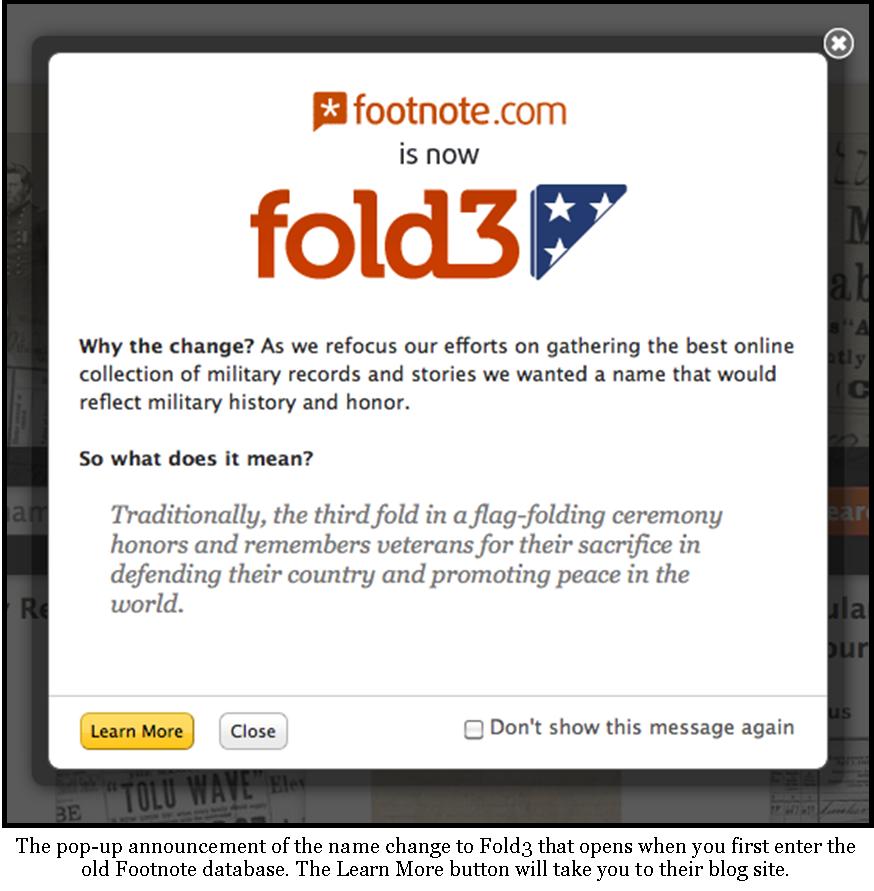
On this day, we'd like to alert you to a change to the Footnote History and Genealogy Archives available to Athens Regional Library System cardholders via GALILEO. Their new name is Fold3, and when you first enter the site, you will receive this announcement of the change:


The name change is in honor of their new focus, which is primarily United States military records. As this is the vast majority of what they already hold, and why many use their site, the change is merely cosmetic for most history and family researchers who use this database. 

The site will not be eliminating their current non-military collections, such as city directories, U. S. Census documents, Native American records, and naturalization files. However, the site will not be adding new collections to these categories, as they move their focus to their military collections. Among the incomplete military collections that will benefit from the new focus are the War of 1812 Pension Files and several World War II collections.

When you visit the database now, the primary difference is the title of site and collections, as seen here:


Please let us know if you run into any problems, but so far, we've found the site is operating as normal. You can contact us at the Reference Desk by calling (706)613-3650, ext. 356, or emailing us at heritageroom@arlsmail.org.


Learn More:


Friday, June 3, 2011

3 June 1917: An "Astonishing" 37.4 Miles per Gallon!


On this day in 1917, Talmage Hardware Company ran the following ad in the Athens Banner:


Talmage Hardware was located at 131 East Clayton Street downtown, where Lamar Lewis Shoe Store is today.

In 1917, the cost of a gallon of gasoline in the United States 20 cents per gallon, approximately $3.22 in today's dollars. The Fuel Administration established during World War I was primarily focused on the nation's coal supplies, and urged citizens to conserve electricity and order their coal early in the winter. Gasoline rationing came in the autumn of 1918, through a voluntary action of "gasolineless Sundays." The war ended before stricter constraints were deemed necessary.

According to a story run on the same page as the ad, demand for automobiles was high in Clarke County thanks to "premium prices" for food crops brought on by the war. All the dealers interviewed had sold out of their stock and had waiting lists for a variety of models. According to Mr. Griffeth, the local Ford agent, "Farmers are buying these handy little machines to haul their produce into town and carry their supplies out." 

The article noted that "with the products of the farm soaring there is no reason why the farmer for once in his life should not ride and ride comfortably," and asserted that such purchases were patriotic support of American industry during a time of war. 

The automobile was also touted as a modern way to improve well-being, with the author quoting famous New York Evening Journal editor Arthur Brisbane, who likened riding in a car to indoor plumbing: "you pay for running water as a matter of course. Just as important...to health is the running air that fills your lungs and clears your blood as your car rushes through it. To call a car a 'luxury' ...is trivial nonsense. As well call running water and a bathtub in your house luxury."


Learn More:


Thursday, April 7, 2011

7 April 1918: Light the Torch of Liberty


On this day in 1918, the following full-page ad appeared on page 8 of the Athens Banner:

 (click on image to enlarge)

The third "Liberty Loan" offered $3 billion in bonds at 4.5% interest, and was issued on April 5, 1918. Created to fund the First World War, Secretary of the Treasury W. G. McAdoo had a wide-ranging publicity program. He embarked on an extensive speaking tour, and commissioned  artists such as James Montgomery Flagg, H. C. Christy, Charles Dana Gibson for an aggressively patriotic poster campaign. Secretary McAdoo also hired movie stars such as Charlie Chaplin, Douglas Fairbanks, and America's Sweetheart, Mary Pickford to tour the country encouraging Americans to purchase bonds.

Anyone and everyone, including troops of Boy and Girl Scouts, could and were encouraged to sell Liberty Bonds. Ads encouraging the purchasing of bonds were placed by local financial businesses, but also Athens Railway & Electric Company, Martin Brothers Shoe Store, Palmer & Sons drug stores, and the Davison-Nicholson department store. Athens also had a local "Libery Bond Committee," which would promote Liberty Bonds as a patriotic duty before showings of movies or other performances, and sent letters to pastors to read to their congregations, encouraging them to buy bonds to "do your part to stamp out Prussian autocracy."


Learn More:

Monday, April 4, 2011

4 April 1916: "No Other Garment Has So Much Power"

On this day in 1916, the W. T. Collins & Company clothing store, located at 335 E. Clayton Street, ran this ad to alert female Athenians to the arrival of a professional corsetiere the following Monday:


Sport corsets were first developed in Paris in 1898, and originally were cut high on the sides so a woman could sit to ride a horse without difficulty. The pressure of the corset was moved from the abdomen to the back, and encouraged a straighter posture and easier movement, allowing women to be more active than the tighter, more restrictive Victorian corsets of the 19th century. The new designs were called either "health" or "sport" corsets.

These 1916 styles advertised in the Athens Banner were heavily reinforced with elastic bands along the hips, allowing for easy sitting and movement but still providing a foundation for the straight, stylish skirts of the period. Their $3.00 price tag is approximately $60.50 in today's dollars. Many corsets after 1917 removed all metal boning due to metal shortages from the war, and most women found the new corsets to be both patriotic and far more comfortable.

Learn More:

Friday, November 19, 2010

Learn All About the Military Records in Morrow and How to Use Them

On this day, we'd like to invite you to a program at the library's auditorium on Saturday, November 20th, 2010, at 2pm. From the National Archives and Records Administration's Southeast regional office in Morrow, Georgia, Nathan Jordan will discuss the military records available at the facility and how to use them when researching your family tree.

Mr. Jordan is a graduate of West Point, a veteran of the Afghanistan war, and is currently pursuing a Master's degree in Public History at Georgia State University. He recently wrote about his own family research on NARA's blog, NARAtions.

This program is free and open to the public, and is co-sponsored by the Athens-Clarke County Heritage Room and the Clarke-Oconee Genealogical Society. A meet-and-greet with light refreshments in the Small Conference Room will follow the program.

For more information, call the Heritage Room at (706) 613-3650, ext. 350. We hope to see you there!

Tuesday, November 9, 2010

9 November 1948: U. S. Post Office Issues Moina Michael Stamp in Athens

On this day in 1948, at 8 o'clock in the morning, the Moina Michael poppy stamp went on sale in Athens, Georgia. Collectors lined up at the windows of the post office hours before they opened, and a parade featuring legion organizations, both University and high school R.O.T.C. and marching bands, and "a number of tanks" led to a ceremony at the Fine Arts Building on the University of Georgia campus. The presentation included speeches by many government officials, and a message sent by President Harry S Truman.

Miss Michael was lauded as "a great American woman, able educator, and valiant crusader who has contributed to veterans of this country and other countries. Her name will always be gratefully remembered by the people of this nation."

The 3-cent stamp, now seven times as valuable, was issued two days before Armistice Day (now known as Veterans Day or Remembrance Day) because it was on November 9th, 1918, that Miss Michael came up with the idea to use the poppy as a symbol of remembrance for fallen soldiers.

In 1918, Miss Michael had taken a leave of absence from her educational work in Athens to volunteer with the YWCA Overseas War Workers training headquarters at Columbia University in New York. On November 9th, the YMCA was hosting the 25th Conference of Overseas Secretaries in New York. During a moment of downtime during the conference, she read the poem now known as In Flanders Field by Canadian Lieutenant Colonel John McCrae in a copy of Ladies Home Journal. She was inspired by the poem to write a response, titled We Shall Keep the Faith.

Later that day, a group of men from the conference brought Miss Michael a check for $10.00, in appreciation of the effort she'd made, at her own expense, to "make a home-like Hostess House of their headquarters." She replied that she would use the money to buy red poppies, "I shall always wear red poppies--poppies of Flanders Fields!" Miss Michael showed the men the McCrae poem, as well as the one she had just written. The men took both poems with them back into their meeting while Miss Michael went in search of cloth poppies, finally finding 25 of them at Wanamaker's department store. She returned to the hall to find men gathered around her desk, asking for poppies to wear in their lapels. It was then Moina Michael had the idea of using cloth poppy sales to raise money for the widows and orphans left behind by fallen soldiers.

A year later, while teaching a class of disabled veterans at the University of Georgia, Miss Michael came to realize that many soldiers who returned from the war needed assistance as well. She campaigned to have the poppy not just a memorial flower, but one of remembrance for all veterans who served their countries. The flower was adopted by veterans groups from around the world in the early 1920s, and before long, Moina Michael was internationally known as "The Poppy Lady." By the time of her death in 1944, nearly $200 million had been raised for disabled vets by the sale of poppies in the United States alone.

Poppies are still made by disabled veterans and sold for Veterans Day and Remembrance Day, in the United States, Canada, Great Britain, New Zealand, and Australia. You can also make your own to wear this Veterans Day, Thursday, November 11th.

Learn More:

Thursday, June 17, 2010

17 June 1914: Athenian Is First Woman to Earn UGA Degree

On this day in 1914, Mary Dorothy Lyndon of Athens became the first woman to receive a degree from the University of Georgia. She was one of three students in June exercises receiving a Master of Arts degree.

Ms. Lyndon had grown up in Athens, attending public schools. She graduated from Wesleyan College in 1896, stayed to earn a graduate degree in Dramatic Arts in 1897, then returned to Athens to earn a 2-year teaching diploma from the State Normal School in 1901. For a time, she studied Dramatic Art and History at Columbia University in New York before again returning to Athens, where she briefly taught English and Athens High School. In 1911, she took a position teachng history at the Lucy Cobb Institute, which allowed her to take summer classes at the University of Georgia to earn her MA degree.

At the time Ms. Lyndon attended UGA, the school was still officially a male-only institution. The school had conferred an honorary Master of Arts degree on writer and educator Julia Flisch in 1899, but in the same year, the Board of Trustees deleted from their minutes the petition for coeducation at UGA presented to them by the Daughters of the American Revolution, the Colonial Dames, and the Georgia Federation of Women's Clubs. In 1911, the Trustees allowed women to earn Master of Arts degrees from credits accumulated during summer school only, "on the pretext that enrollment in summer school did not constitute formal admission to the university."

Two years after Ms. Lyndon was awarded her MA degree, Chancellor David C. Barrow asked the legislature to allow women to attend regular sessions of the graduate school. The Trustees balked at the notion of women officially on campus, and Chancellor Barrow looked the other way while professors instructed female students privately to earn credits they could, with a letter of recommendation, transfer to other schools in the United States.

World War I changed the political landscape for coeducation. President Andrew Soule of the Agriculture College, a strong advocate for admitting women into the University, was made Georgia's Federal Food Administrator and Regional Chairman for five southern states. He used his position to push to allow women into the College of Agriculture to become nutritionists, using the patriotic argument that educating women would be "another form of conservation" during the war. The resolution passed an interim committee of Trustees, and that fall, the Department of Home Economics opened with Mary E. Creswell as the Dean and 46 students in the program.

The following year, in 1919, the Trustees recommended that "a woman be elected Associate Professor of Education and also be made Dean of Women." Chancellor Barrow offered these positions to Ms. Lyndon, for she "possessed of an equitable disposition, a keen intelligence, boundless energy, and a love and sympathy for young people."

While Dean, Ms. Lyndon started the Pioneer Club, directed the coeducational Thaliana Dramatic Club, started women's basketball and rifle teams, and oversaw the establishment in 1921 of the first sorority on campus, Phi Mu, of which she had been a member at Wesleyan. Her career came to an abrupt end when she was stricken with a fatal bout of pneumonia while visiting cousins in Washington, Georgia. Mary Lyndon was only 46 years old.

Learn More:

Thursday, May 6, 2010

6 May 1918: Time Changes for the Streetcar Schedule

On this day in 1918, the Athens Daily Herald published the "slight adjustment of schedules" by the Athens Railway & Electric Company "to meet present conditions." The new schedule was published daily for a week.
From 5:15 a. m., city time, or 6:15 a. m., government time, a half-hour schedule will be operated for one hour, making all connections for the early trains.

From 10:50 p.m., city time, or 11:50 p. m., government time, a half hour schedule will be operated on the Milledge and Lumpkin belt, the M. and L. cars alternating every fifteen minutes from downtown, M. car 10:50 p.m., 11:20 p.m., and 11:50 p.m., and L. car 11:05 p.m., and 11:35 p.m., city time.
"Government time" refers to the first institution of Daylight Saving Time by the United States, though it had been used in Europe since 1916. Congress passed the law establishing the use of Daylight Saving Time on March 19, 1918, as a way to conserve energy during the First World War.

The law went into effect on March 31, 1918, and also established the first official time zones in the United States. The time change was unpopular, and was repealed in 1919. President Franklin D. Roosevelt re-established the use of Daylight Saving Time in 1942, using the moniker "war time."

After the end of the Second World War, the shift to Daylight Saving Time was considered a local issue, but the inconsistencies caused enough problems that in 1966, Congress passed the Uniform Time Act. States could choose to opt out by passing a bill in their legislature. Today, only Arizona and Hawaii do not observe Daylight Saving Time.

Learn More:

Wednesday, March 3, 2010

3 March 1918: "Such Foodstuffs As Food Law Permits" during WWI

On this day in 1918, the Athens Banner published a list of acceptable wheat flour substitutes "in order that there not be any misunderstanding in the part of the merchants and buyers."

The list ranged from such recognizable items as bran, corn meal, hominy, rolled oats, buckwheat flour, and oatmeal to cotton seed flour, feterita meal, kaffir flour, milo, cassava flour, and banana flour. Rye and graham flour could not be substituted for wheat flour purchases.

When the United States entered WWI in 1917, Europe had already been at war for three years and was desperate for food. Work by agencies such as the Committee for Relief in Belgium, organized and headed by Herbert Hoover, had been feeding civilians in Allied nations for years, but now the U. S. needed well-fed, strong armies as well. President Woodrow Wilson created the U. S. Food Administration, and asked Hoover to run the temporary department.

Hoover accepted no salary for his work, and set about creating a public relations campaign that made conserving food, especially meat and wheat, and growing one's own food, patriotic duty of all Americans. Slogans such as "Food is Ammunition--Don't Waste It!" and "American Wheat to Win!" were taken to heart. Commercially produced breads could not contain more than 50% wheat, and limitations were made on wheat flour to citizens, who were encouraged to sign a pledge to conserve food, and to substitute foods, such as corn in place of flour, whenever possible. By September, 1918, commercially produced breads and mixes could be 80% wheat.

Georgia State College of Agriculture President Andrew Soule was the federal food administrator for Georgia and chairman of food administration for five southeastern states. He was frustrated by the lack of nutritionists available to work with the public during this time, and took this opportunity to push for the University of Georgia to start allowing female undergraduate students. Nutritionist was an acceptable job for women, and along with working with the extension services, Soule made the case that allowing women to be educated for these much-needed professions was "another form of conservation." By September, 1918, Soule had set up a Department of Home Economics and the University was now officially a co-educational institution.

Learn More: